Most people arrive for a first laser session having read either marketing copy or horror stories. The truth sits between the two, and it is far less dramatic than either. Here is the honest version.
Before anything is switched on
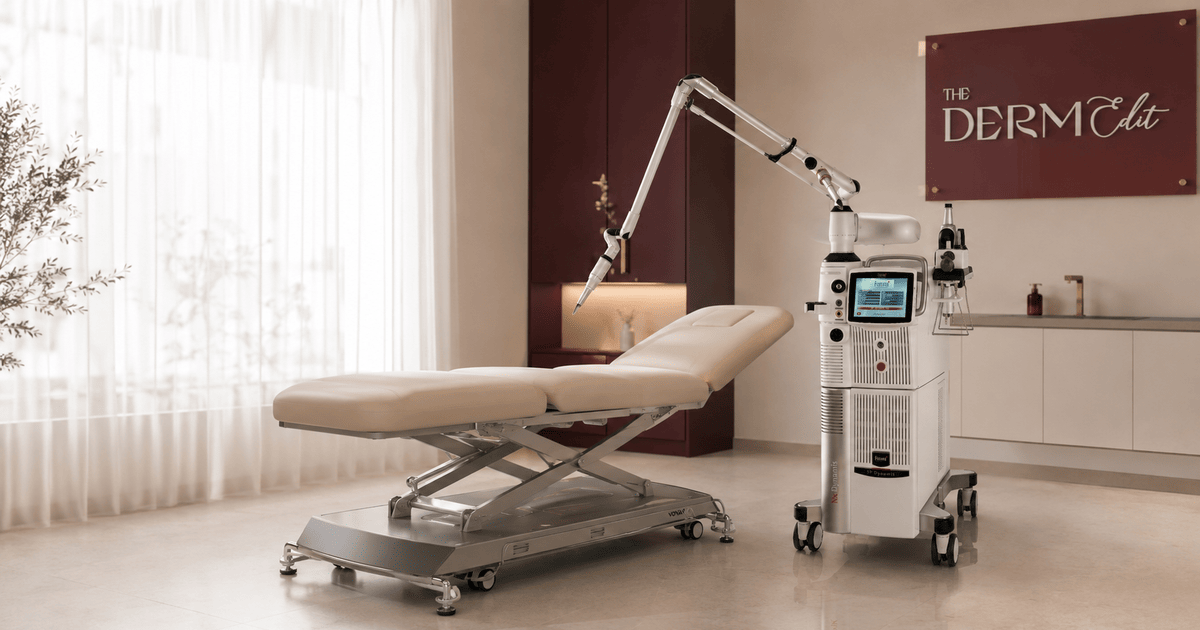
A laser is a tool, not a treatment. What decides your result is the diagnosis that comes first — and the settings a doctor chooses afterwards. At your first appointment we examine the skin, ask what you have already tried, note your medicines and sun habits, and only then decide whether a laser is even the right answer. Sometimes it isn’t, and we say so.
Two things matter enormously in Indian skin: your skin phototype and your tendency to pigment after inflammation. Both change the wavelength, the energy and the spacing between sessions. This is precisely why the same machine produces beautiful results in one clinic and burns in another.
On the day
Preparation
- Come with clean skin — no makeup, no sunscreen on the treatment area.
- Retinoids and exfoliating acids are usually paused a few days before; we tell you exactly when.
- Avoid deliberate sun exposure or tanning in the fortnight before. Freshly tanned skin changes the safety margin.
- Tell us about new medicines — especially isotretinoin, antibiotics that cause photosensitivity, or anything started since your last visit.
Numbing
For most non-ablative work, cooling is enough. For resurfacing and scar work, a topical anaesthetic sits on the skin for about 30–45 minutes first. That waiting time is part of why you should budget more clinic time than the “session length” suggests.
What it feels like
Patients describe non-ablative passes as warmth with an intermittent flick — a rubber band snapped lightly against skin. Ablative and fractional resurfacing is stronger: a hot prickling that stops the moment the handpiece lifts. Cooling runs continuously. Nobody has to endure a session in silence; we adjust as we go.
The week after, honestly
Downtime depends almost entirely on how deep we went.
Non-ablative (toning, gentle rejuvenation, laser hair reduction)
- Hours 0–6: pinkness and mild warmth, like light sunburn.
- Day 1: most people go to work looking normal. Makeup is usually fine after 24 hours.
- Days 2–7: nothing visible. Sunscreen is non-negotiable.
Fractional resurfacing (texture, scars, pores)
Published recovery timelines for fractional Er:YAG resurfacing describe roughly 2–5 days of visible downtime, with most people comfortable returning to work around day 5–7 — and customer-facing roles sometimes waiting a little longer. In our experience that matches: the first three days are the most obvious, then improvement is rapid and daily.
- Days 1–3: redness, a sandpaper texture, mild swelling. This is the treatment working, not a complication.
- Days 4–6: fine flaking, like a peel. Do not pick it.
- Day 7 onward: skin looks fresh; residual pinkness fades over the following week or two.
Non-negotiables afterwards
- Sunscreen, daily, generously. Freshly treated skin pigments easily — this is the single most common reason a good result is spoiled.
- No picking, scrubbing or actives until we clear you.
- Message us if anything looks or feels wrong. We would far rather answer a small question early.
How many sessions, really
Almost nothing worth doing is a one-session job. Collagen-based change — texture, scars, laxity — builds over roughly 8–12 weeks after each session and continues improving well after the course ends. Pigment work is a course, spaced deliberately. Hair reduction follows the hair cycle, not the calendar.
What we can promise is honesty about the number before you start, progress photographs at each review, and a plan that changes if your skin responds differently than expected.
Who should wait
Active infection at the site, recent isotretinoin in some protocols, unstable pigmentation, pregnancy for certain treatments, and uncontrolled photosensitivity are all reasons to postpone rather than proceed. A clinic willing to treat you regardless is not being helpful.
- Erbium laser resurfacing recovery timeline — clinical overview
- Fotona — skin resurfacing treatment information
This article is general information, not medical advice, and it isn’t a substitute for examination. Individual results vary. Any treatment mentioned is undertaken only after consultation and assessment by Dr. Sarat Anandh, MD DVL.