Dandruff does not destroy follicles — but the inflammation and scratching around it can increase shedding. What a dermatologist checks, and what actually settles it.
In short
- Dandruff does not cause permanent baldness.
- It can increase shedding through inflammation, itch and scratching.
- This kind of hair fall is usually reversible once the scalp settles.
- If shedding continues after the flakes clear, something else is going on.
If you have noticed white flakes on your shoulders alongside more hair in the drain, you are right to connect the two — but the link is indirect.
Dandruff itself does not permanently damage hair follicles or cause baldness. What it does is create an unhealthy scalp environment. Itching, inflammation and constant scratching weaken hair roots and increase temporary shedding. Diagnosed and treated properly, that shedding usually reverses.
At The Derm Edit, scalp and hair concerns are assessed together rather than separately — because in most patients they are the same problem.
How dandruff drives hair fall
Dandruff is usually caused by overgrowth of a naturally occurring scalp yeast, which triggers inflammation, irritation and flaking. That changes the scalp in ways that matter for hair:
- Inflammation develops around the follicle
- The root weakens
- Scratching causes mechanical breakage
- The growth cycle is disturbed
- The scalp stops being a good place to grow hair
Increased shedding, yes. Permanent loss, generally not — provided it is treated rather than tolerated.
Symptoms that deserve a consultation
- Persistent white or yellow flakes
- Itch that does not settle
- Redness or irritation
- An oily scalp with scaling
- Hair coming away while combing or washing
- Scalp discomfort lasting more than a few weeks
Most people wait months before asking. The scalp does not improve on its own while it is still inflamed.
When the hair fall is not the dandruff
Hair fall has many causes, and dandruff often sits alongside another one. A proper assessment looks for:
- Male or female pattern hair loss
- Telogen effluvium (stress or illness-related shedding)
- Nutritional deficiency
- Thyroid disorders
- Hormonal imbalance
- Scalp psoriasis
- Seborrhoeic dermatitis
- Fungal scalp infection
Each of these needs a different treatment, which is exactly why the diagnosis has to come first.
How we assess it
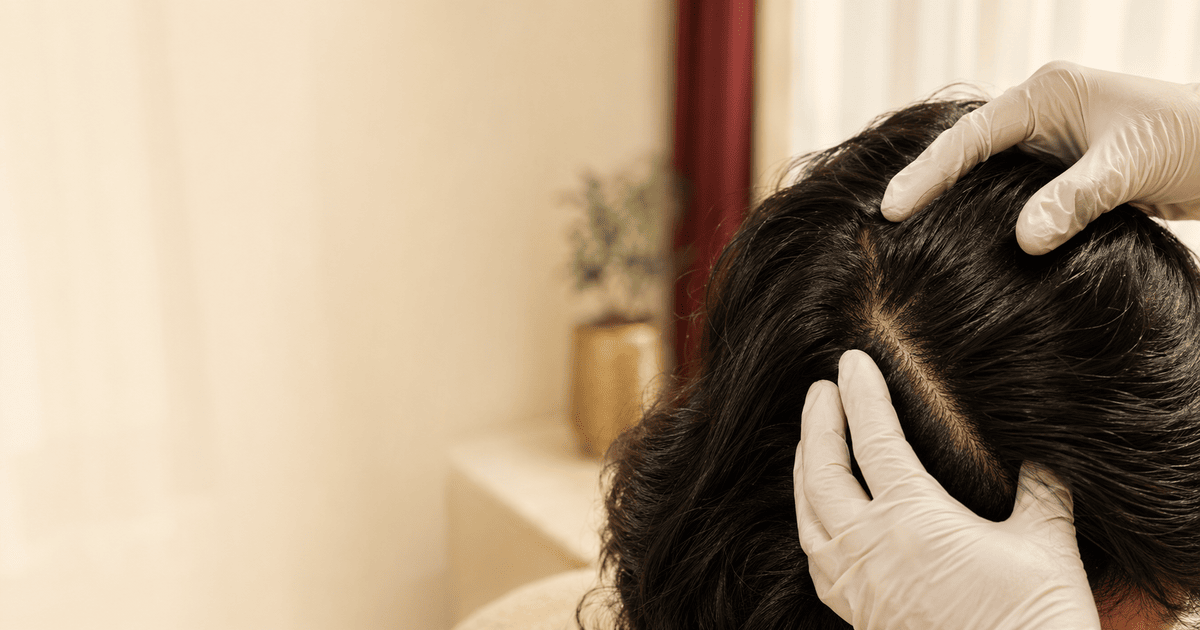
Consultation begins with a full scalp examination and includes:
- Detailed history
- Scalp examination, with trichoscopy where useful
- Hair density assessment
- Evaluation of scalp inflammation
- Identification of fungal or inflammatory disease
- Blood work for nutritional or hormonal causes where indicated
The aim is to treat the actual cause rather than mask the symptom. That is what we test before treating hair fall.
What treatment usually looks like
Medicated cleansers
Dermatologist-selected shampoos containing ketoconazole, selenium sulphide, zinc pyrithione or salicylic acid reduce fungal load, inflammation and flaking. What matters is the right agent, the right frequency and the right contact time.
Prescription scalp medication
For moderate to severe cases, topical anti-inflammatory treatment is added to bring the scalp down quickly.
Hair fall management
Where shedding has already started, treatment may include medical hair growth therapies, scalp treatments, nutritional correction where indicated, and a realistic home routine.
Scalp care that holds
Frequency of washing, product selection and technique are not trivia — they are most of the recurrence problem.
Daily habits that help
- Wash regularly with a shampoo chosen for your scalp, not your hair type
- Do not scratch, however satisfying
- Manage stress; sleep properly
- Eat enough protein, iron, zinc and vitamins
- Reduce heat styling
- Keep the scalp clean in humid weather — Chennai is unforgiving here
Why early treatment matters
Home oils and DIY remedies can feel soothing but rarely address fungal overgrowth or inflammation. Treating early reduces inflammation, limits shedding, improves scalp health and lowers the chance of the whole cycle repeating in three months.
Frequently asked questions
Can dandruff cause permanent hair loss?
Not usually. Dandruff itself does not destroy follicles. Untreated inflammation and heavy scratching can increase temporary shedding.
Will treating dandruff reduce hair fall?
Often yes. Once inflammation is controlled, shedding usually improves — provided there is no separate cause running alongside it.
When should I see a dermatologist for dandruff?
If it persists beyond a few weeks, becomes severe, or comes with noticeable hair fall, redness or itch.
Can stress make it worse?
Yes. Stress can trigger both seborrhoeic flares and increased shedding, which is why the two often arrive together.
Does oiling help dandruff?
In most patients it makes it worse, because the yeast involved feeds on scalp lipids. It is one of the commonest reasons dandruff does not settle.
Where can I get dandruff and hair fall treated in Chennai?
The Derm Edit treats scalp and hair concerns together at our Mogappair clinic, for patients across Anna Nagar and Chennai.
This article is general information, not medical advice, and it isn’t a substitute for examination. Individual results vary. Any treatment mentioned is undertaken only after consultation and assessment by Dr. Sarat Anandh, MD DVL.